
What I learned about innovation in a decade across Paris, Amsterdam & Helsinki
Innovation in Europe is no longer about the best products or pilots. It is about translation between technology, customers, institutions and society.
Lauri Aarnio
5/28/20269 min read
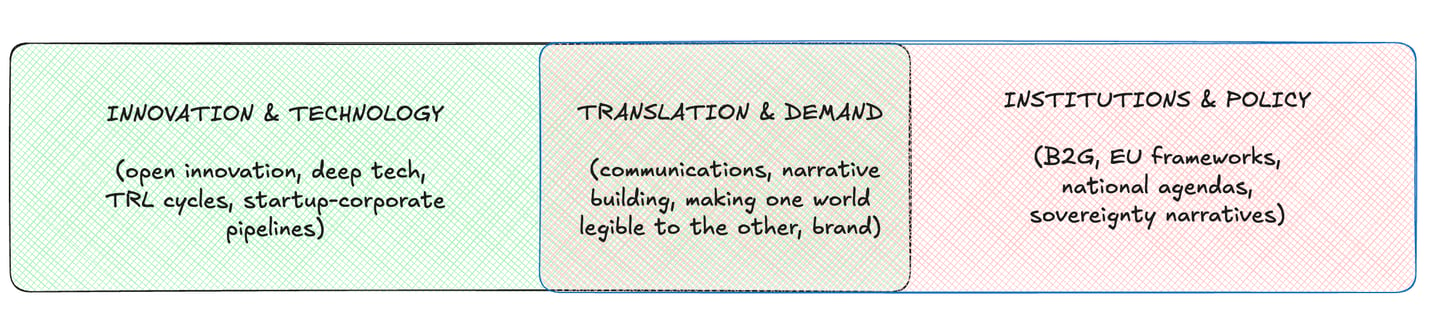
The past decade spent in the European technology and innovation ecosystems shaped my thinking more than I could have imagined.
My mind pictures a mosaic of "trends", beliefs, realities and opinions that echoed along the office corridors I took from one work place to another, from intern to Head of department.
Coming from Finland, I absolutely loved the certain chaos that Paris represented, the endless amount of different cultures and the rich workplace where we would all learn from each other.
Slush in Helsinki was my first real exposure to what a startup ecosystem could look like when a small country approaches the potential strategically, long before I fully understood what any of it meant for my professional future.
Working in Paris at the heart of La French Tech, I frowned upon comments on the French "laziness" or "inefficiency"; it is here where I met, still to date, some of the most hard-working people who were never afraid of putting in the extra hours to deliver exceptional work.
Why our work always needed dedication and long hours? Countless clients from big corporations to EU institutions needed help in framing their pain points. They also needed help explaining why they need to advocate a certain technological breakthrough to achieve their goals versus deciding not to capitalize on another tech stack.
Conversations that would at times seem chaotic to outsiders, changing between three languages within one business meeting. Long nights and weekends traveling the European continent for tech events and at times overseas to LATAM and East Asia.
As a professional who made the choice to adopt Paris, and the French, (or maybe I should say, they ended up adopting me), I used to think that my super power was my adaptability to any given situation. I had also thrived in the Netherlands, mindset-and friend-group integrated, trying to learn their language to a level of minimal understanding, even though the Dutch self-label the language often as difficult beyond hard.
Bold choices throughout my twenties, that some systems are tough to reward, ended up teaching me the most
What is evident in innovation too, the more you iterate, test and adapt to unforeseen situations, the better your product or service. You go the extra mile to get out of your comfort zone to understand and immerse yourself in the given context. Not just waiting and wishing for a breakthrough.
That's the mindset that enabled me to thrive in fast-paced environments juggling multiple projects at once while not losing sense of clarity and purpose.
In a decade, things are changing in France too, slowly but surely. When I started working in a permanent role in Paris, in 2017, it was still quite unusual to have done a plethora of multi-disciplinary studies across different countries, mixing self-complementary topics.
When we look at the situation now, it's evident that the realpolitik realm of technology, innovation, business and policy, is intertwined, there is no one without the others.
I learned to treat innovation like translation work, between engineers, operators, and institutions
I argue this translation capability is the essential skill of the 21st century for those working in the tech industry with a generalist or business background.
Our societies' complex, nuanced problems from decarbonisation to technological sovereignty, defence and climate change, are topics that are hard to decipher and explain if we do not possess a broad spectrum of knowledge about different sectors, we are unable to choose what is meaningful for progress. At least, this is, for business, marketing and communications experts, who are not coding the innovation or building it in the labs with scientists.
Think of hackathons or design thinking; digital transformation was always performed at its best with cross-functional rooms full of different profiles.
From early AI adopters to structured open innovation and B2G (GovTech)
Open innovation was nothing new, the OECD was already describing, as early as 2008, (OECD, 2008), the move toward opening the innovation process as firms faced shorter product life cycles and more distributed expertise.
Recent European work frames corporate-startup collaboration as a core capability rather than a side experiment.
The European Innovation Council's 2025 report notes that what used to be peripheral is now "seen as a core element", and points to a structured pipeline of engagements and deals through its Corporate Partnership Programme (EIC/EISMEA, 2025).
Separately, the Open Innovation Report 2023 finds that 69% of corporates say they want to collaborate with startups within the next 18 months (Sopra Steria ScaleUp, 2023).
What changed is not the ambition to 'partner', but the operating model: systematized pipelines for scouting, PoCs, pilots, and integration, with governance that created venture clienting (already in 2014-15, by Gregor Gimmy at BMW).
However, I witnessed with my own eyes a substantial acceleration from 2017 to 2026, open innovation became operational, with faster cycles, easier to explain business cases and ROI, which led to better-governed open innovation programs and the method's adoption across corporations, startups and CVCs.
These programs would be run in chains for years, with little to no rebranding needed.
New waves on the horizon
At BeMyApp, a digital transformation and open innovation agency, I was building a tech startup community specifically to accelerate open innovation projects, connecting startups with real-world opportunities that would have been ignored otherwise. It was not theoretical; the pipeline was live and the mismatches between corporate need and startup capability were visible and fixable in real time.
Being part of the wave in Europe where open innovation got structured, countless new APIs were developed to generate pools of open data, and open source software, was an interesting chapter to witness before the pandemic.
It seemed as if even in Europe, where tech and innovation investments were hugely lagging behind the US and China, industrial and innovation problem framing techniques had created a new ground for faster integration of new methods, technological plugins, and started to produce real working prototypes that were not just going to be left on the shelf to collect dust.
It was also the moment I realised that innovation only works when someone can translate corporate needs, startup capabilities and institutional constraints into a shared language.
The Covid-19 pandemic for its part, accelerated the innovation wave even further since we had to further adopt virtual innovation and therefore by nature make it even more global.
Oftentimes these projects were connected to "tech for good"-concepts, which sound awfully outdated now in 2026, but the red line was there: open innovation and startup-corporate alliances could be vehicles for planetary causes and positive impact.
Betting on sustainable technologies and societal causes created cohesion in external brand communications and events, and the latter were natural extensions of the messaging around a company's commitment to sustainability (however, often also used for greenwashing, let's be real here).
Innovation and deep tech events that worked as a platform for showcasing national innovation and attracting FDI
In 2017, tech-adjacent conferences were often innovation branding for governments.
By 2024-2026, the topics got increasingly tied to sovereignty, reindustrialisation, defence, AI strategy, and scaling through VC money.
Delegations and national pavilions became recurring budget provisions for governments, and some of them chose to go to the same event year after year.
At Hello Tomorrow, we were animating a community of thousands of deep tech startups through curated content, campaigns and opportunities, including the Global Challenge which drew 4,000+ applications annually.
When the Dutch delegation showed up year after year to the Paris flagship, it was not a coincidence; it reflected real institutional appetite for what the program had built.
A good example of this is the world-known deep tech event, Hello Tomorrow Summit, where I had been for the first time in 2017. It attracted loyal Dutch delegations to its flagship event in Paris for numerous consequent years.
Due to increasing commercial and strategic ties with the Dutch network, it decided to move its event to Amsterdam since 2026. This is a good example of tangible interoperability and complementary tech policy interests within the EU.
These delegations were not just symbolic; they showed that innovation platforms are never idle. They move across borders according to corporate and international priorities, and they require translation between national agendas, corporate interests and EU priorities.
This shift makes the same events feel more "B2G" even when they look like marketing on the surface.
Nowadays, governments, as much as enterprises, seek meaningful and new ways to portray their commitment to tech fairs, but still struggle to showcase the ROI and the fit for their brand.
Initiatives such as Choose France, Invest in Finland and NFIA (Netherlands Foreign Investment Agency), are good examples of the driving forces behind national tech agenda pushing through events.
My job was often to translate deep tech into an institutional narrative that multiple actors could stand behind, to drive demand, empower the narrative and get things shipped faster.
The real brands invested in sustainable innovation were the ones actually investing in green technologies and giving money to founders who needed help in scaling.
Think of hubraum, Deutsche Telekom's incubator, and its continuous commitment to sustainable IoT and 5G networks; they scouted for new innovators through open innovation calls and enabled a generation of forward-thinking startups to push their sustainable solutions to the market through partnerships.
That's what got me hooked essentially; forging partnerships through marketing programs to foster green innovation and support entrepreneurship.
Ecosystem growth: the French ecosystem from 2013 to 2026
From 2017 to 2026, Paris stopped being 'a promising ecosystem' and became one of the top tech agglomerations infrastructure.
STATION F alone has supported 7,000+ startups since opening, with fundraising accelerating from roughly €350m in 2018 to €1bn+ a year since 2022, and €1.5bn raised in 2025. (Station F)
On the institutional side, Bpifrance scaled to industrial levels, injecting €60bn into the economy in 2024, and €72bn in 2025, which is a very different order of magnitude from the earlier part of the decade, deep tech becoming a huge strategic lever of growth and resilience for France and Europe. (Bpifrance)
Numerous initiatives such as an organisation accelerating deep-tech ecosystem orchestration in France, and beyond, France Deep Tech, and a national tech investment plan, France 2030, to help the French reindustrialisation, were created. Not to forget, French deep tech delegations have been sending their red-rooster-pin-wearing ambassadors to other parts of the EU and overseas through the 'La French Tech'-network to increase ecosystem connections.
The shift I saw up close
I lived the shift from "SaaS + growth" narratives, to an AI-led redefinition of work (and fear of a SaaSpocalypse), and then into a further emphasized B2G moment where public policy, procurement, standards, and sovereignty questions shape what gets built and adopted, not least for the benefit of the Defence industry.
It did not happen in a straight line, but it changed what communication and marketing are for.
In the mid-2010s, "digital transformation" often meant shipping a new product, running an innovation lab, or launching pilots to prove movement. The comms playbook was clearer: position the product, show traction, fuel adoption, and build category.
Why multi-disciplinary communicators and partnership professionals matter more now
Our job is no longer "tell the story after the fact". It is to sit close to product, research, regulatory, partnerships, and policy, and build coherence early to prepare the terrain for successful adoption and launches.
Translate complex technologies into tangible use cases that are tied to reality instead of jargon
Connect societal stakes to concrete product and adoption paths, like in the case of Open Source communities (check out my blog post about OSS & digital sovereignty), forging connections between different ecosystems
Frame partnerships so they feel real, not symbolic; finding the DNA of each player and portraying that to the external world so that it strengthens the support
Enhance brands that carry across shifts in societal, customer and policy debates
Given the threats of the current world order, deep tech storytelling jumps rather quickly to sovereignty narratives and EU cross-border fragmentation, and EU-US-China comparison, where the innovation and product needs a different frame depending on the target audience, a ministry, a corporate customer, or a VC fund.
Pushing for initiatives that strengthen European entrepreneurship and scaling, such as EU Inc, is increasingly becoming part of the agenda, and the scope of what counts as meaningful work that supports growth beyond a single company’s interests continues to evolve.
Takeaways:
Too often we also forget the role of communicators, partnership managers and marketers in explaining the prevalent technologies to the wider public, as mass-understanding equals stronger foundations for everything adjacent to the technology.
A "normal citizen" with basic education needs to understand, at least to some extent, why investing (public) money in electrification or a medtech solution that removes microplastics from human bloodstream, are both important, but not in the same equation.
This, I argue, contributes to democratic order and fights against the formation of isolated tech-policy-elites.
The real work of innovation now happens in the spaces between disciplines, institutions, and narratives, aiming to activate multi-stakeholder groups for long-lasting adoption.
Most EU strategies converge on 2030, which makes the next four years a decisive window for deep tech, open innovation and tech sovereignty.
Let's talk if you're navigating the space between technology, corporate customers, institutions and markets and need someone who has worked both sides of that translation.
Sources:
Nordic Innnovation, Corporate Startup Collaboration Report, 2019
European Innovation Council / EISMEA (EIC BAS), Unlocking Innovation through Corporate‑Startup Collaboration: The EIC Corporate Partnership Programme, June 2025
BCG, Most Innovative Companies, 2021
BMW Venture Clienting, Press release, 2025
Station F, 8 years of innovation, Roxanne Varza, 2025
Bpifrance, Paper from 2026
Sopra Steria ScaleUp, Open Innovation Report 2023: Surviving the Storm, 2023
MIT Sloan, 20 years of Open Innovation, 2023
Dealroom, 2026 Tech Ecosystem Index & Dealroom, Cities, Paris, 2026
OECD (2008), Open Innovation in Global Networks (9789264047693). PDF.
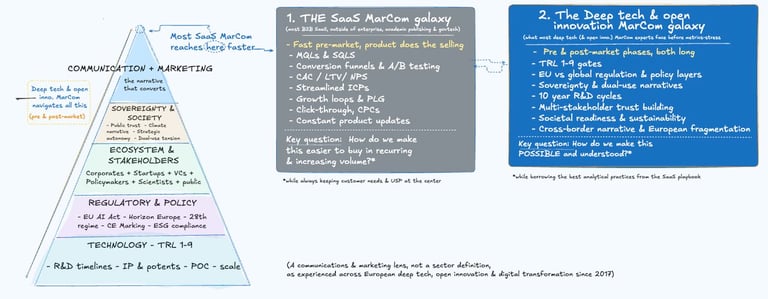
On a more operational side, what often still needs to be in the equation of a marcom-professional; shipping lead generation, performance, and growth campaigns in rapid bursts during those high-intensity peak seasons (often around events) becomes more systematized.
It stops feeling like an eternal limbo of actions after actions.
And suddenly, even small strategic variations in the low-hanging-fruit techniques start to compound, and that becomes a gain, and data will just improve the process for next cycles and partnerships.